
St. Martin to BVI, USVI, and Puerto Rico

At the end of February, my final crew person for this year's cruise arrived. Sonja, 70, from Blaine, WA, is of Austrian heritage but was born in South Africa, which made for some interesting background sharing. Somehow, my last three crew have had Germanic ancestry, as well as I do from my mother’s side.
So, we started this part of the cruise in Sint Maarten. The main Dutch city in Sint Maarten is Philipsburg, not Fredericksburg, as I said in the previous blog. We hopped on a bus one day to take a look at the city's beachfront bay tourist shops, restaurants, and all the beach umbrellas and chairs. It was an interesting and funky place with all the push to sell wares, but not oppressive, I must say. It was fun to sample food and see what was going on there. Interestingly, that day, four huge cruise ships had dumped their passengers on the beachfront, but it never had the feeling of being overloaded. Quite commendable, I think, for the city to be able to handle them all.

Anyway, after checking out some favorite spots in Marigot (the capital of St. Martin, on the French side of the island) with Sonja—especially the pastry shops—we sailed to the small town of Grande Case for their every Tuesday night street party for five weeks during their celebration of Carnival. It was pretty lively with several musical groups playing and dancing, and lots of craft sellers and food stands set up in the main street.


The next day, it all returned to usual small-town business and traffic, and we caught a bus to Orient Beach on the other side of the island. We got to see parts of the beach area I hadn’t seen before and found there were half as many people as when I last visited. The wind was blowing hard, and the surf was really crashing, so I imagine that was the reason why. On the way back, we walked to a big supermarket to stock up on needed items, and stopped in at a pastry shop we had Googled and had some delicious French pastry, which wasn’t on our “needed” shopping list! Quite yummy . . .
After getting back to Marigot to fuel up, the next day was a 12 ½ hr sail and motor-sail to Spanish Town, in the British Virgin Islands (BVI). It made for a long day, and we had to kick in the engines to give a good boost in speed to get there before it got dark. Made it by 20 minutes. Even though anchoring in the dark isn’t impossible—you have to watch the depth finder and electronic chart display closely—but I prefer not to.
The Virgin Islands, both US and British, are quite different geologically from the larger, taller islands further south that I had been sailing the last two years. These are built up primarily by undersea volcanoes, which were later pushed above sea level by plate tectonic activity, whereas the southern islands were formed by above-sea-level volcanoes spewing lava into the typical shape of high volcanic cones. Except for the softer sedimentary rock formed from erosion, the typical rocks are hard, such as granite, which most of us are familiar with. Consequently, the coastline of the islands has huge ocean wave-worn boulders and many beaches along the shores. The beaches, in particular, make both the USVI and BVI islands attractive to visit. And we did our best to visit as many as possible!


Scattered amongst the rocky shores and beaches are many large and small bays where we could anchor and visit the shops ashore, or simply enjoy watching the activity of boats coming and going. Some of the boats we had seen many times during our travels from one anchorage to another in these islands, and some we recognized from travels further south, even. Neighbor-watching is a nice, casual activity for cruisers—an innocent thing, even if a bit nosy! Here are some favorite BVI spots.


After four weeks in BVI, it was time for the USVI, right next door. The first job was to get checked into this part of the United States territory. Of course, it looked very much like the British side, with some differences, some cultural from history, but the big one is geographical: three main large islands that are visited most, instead of the BVI's two, medium-sized, stringy islands plus lots of smaller ones where most boats go.
Of the three in the USVI, the most cruised and visited is St. John, which is where we spent our time. It is surrounded by all sizes of bays and beaches, making more room for boats to anchor and fewer people on most beaches, though nearly all of them have road access for automobiles, too.
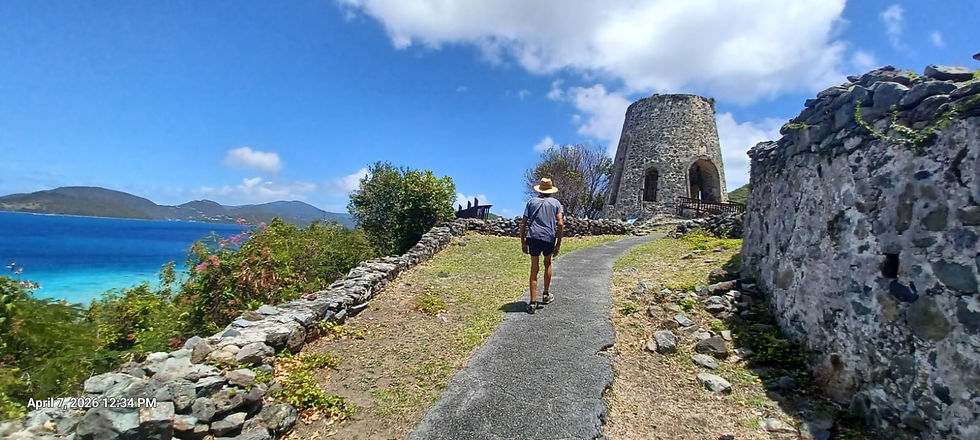
After the Danish colonial period of sugar cane plantations beginning in 1718, the island was sold to the US in 1917 for use as a WWI naval base. During the 1950s, conservationist Laurance Rockefeller purchased about 60% of the land, and in 1956, he donated it to the US government for the creation of the Virgin Islands National Park, which is where we spent most of our time cruising. Here are some of our favorite places.



Next stop was Puerto Rico to check in with US Customs again, after the USVI. We stopped at Fajardo on the west end of that huge island, and then sailed southeast to the island of Vieques. We had about two weeks before returning to Fajardo, where I would haul out the boat for storage on land during the summer/fall hurricane season. Since I had been there 18 years ago, I knew that Vieques would be a great place to hang out near some nice beaches, so off we went!
One place we did take a trip to that wasn't a beach was the bay of Puerto Ferro, which had bioluminescent plankton. To do this, since you could only see their light when it was very dark, we took a 1 1/2 hour kayak tour starting at 9:00 pm--and no lights allowed, of course. There were seven double kayaks in the group, and we paddled around in the bay with our knowledgeable guide, watching the plankton brightly light up when our kayak, paddles, or hands disturbed the microscopic creatures in the water.
It was a fun time, but when I was there 18 years ago, it seemed there was a brighter display. Of course, then we were allowed to anchor in the bay at night, and we disturbed the plankton when we swam in the water, jumped in, etc. Today, they maintain strict regulations as to what goes into the water and work at conserving the uniqueness of the site. Can't argue with that.
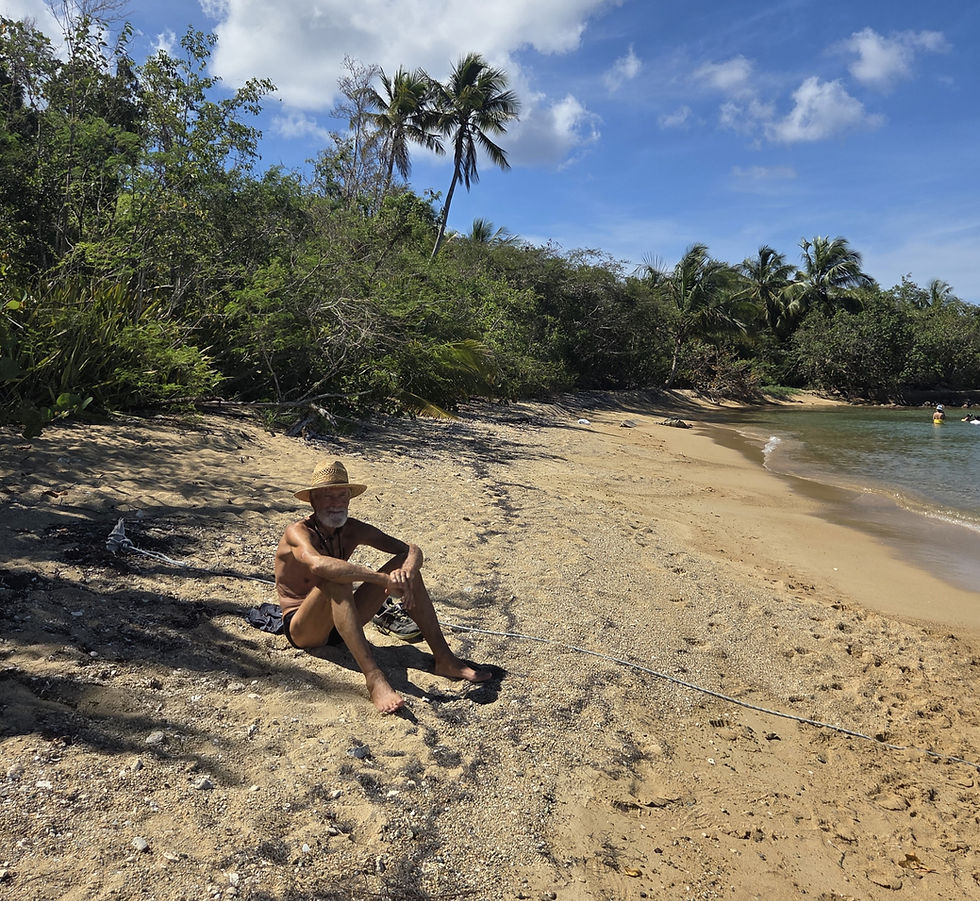
The rest of the time, we looked around the small town of Esperanza and simply awaited haul-out time anchored off the west end of the island at Punta Arenas, where there was lots of beachfront and some snorkeling to be done.


What a wonderful account of your journey, Lance. I really enjoyed how you combined the beauty of the islands with the history, geology, and everyday experiences of life at sea. The bioluminescent plankton experience especially stood out to me. It sounds like an unforgettable adventure.
Thank you for your insightful observations. I especially liked the geology and Carnival bits. I hope you have Sonja along next year. Always good to have company!
I'm so glad you're home safe. Enjoy your summer!
Paul